
Prologue
I own a little French picture book called La grande fabrique des mots—The Big Word Factory. From the moment I read it, I found myself wondering, How did that city come to be? It’s a place where people have to buy words just to say what they think or feel. That might sound absurd, but the more I look at our world today, the more I see the opposite: speech everywhere, so cheap and constant that it’s often meaningless.
Fifty years ago, if you said something not worth hearing, it would just die out around the dinner table. Now, everything we say—no matter how trivial—can circle the planet in an instant, boosted by algorithms that don’t care if it’s wisdom or garbage. And yet, for all this talk, I feel like my daily experiences are so different. My references, quotes, and anecdotes so often land on deaf ears or receive that deer-in-headlight stare. They whoosh past people, unnoticed. So many words lost, so much effort wasted, so many possibilities aborted.
I come from a family of writers and poets. My father is a writer, my grandfather was a poet—my father, too, is a poet, and I was one once as well, back when love inspired me. To me, words aren’t cheap. They’re an art form on par with music or painting. I’ve had moments that proved just how powerful carefully chosen words can be. But more often, I’ve felt like the little boy in The Big Word Factory, straining to be heard in a world that doesn’t really listen.
So I wondered: What brought that fictional city to such an extreme? I wanted to imagine the heartbreak or epiphany that led a whole society to decide, “We must put a price on speech.” And more than that, I wanted to explore how they actually managed to do it—since this doesn’t seem possible in our 21st century, no matter how strong our convictions might be against the oligarchy of algorithms.
That question—How did the Big Word Factory begin?—is what inspired the pages that follow.
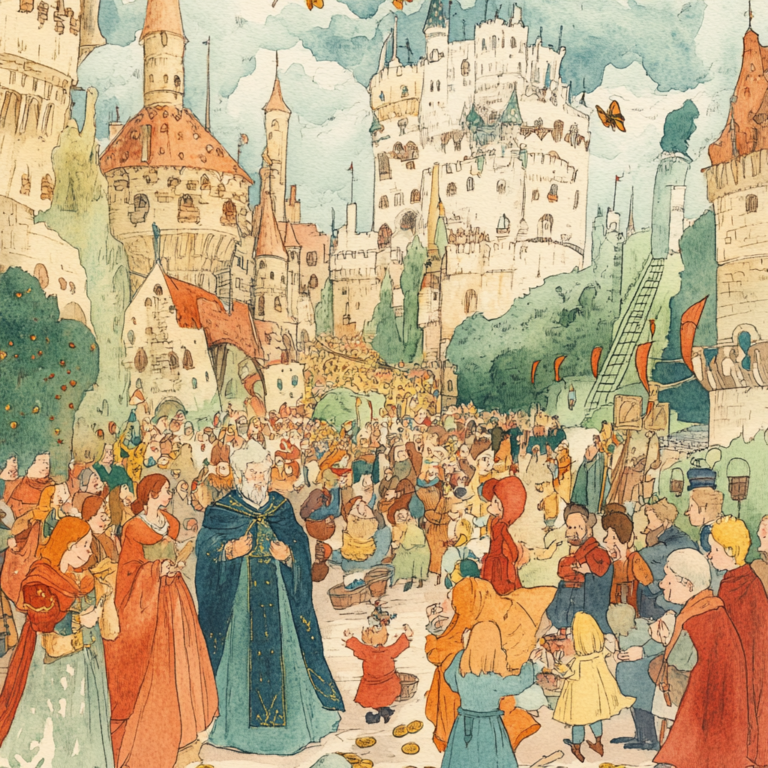
They say the king’s cloak was woven from the night sky, threaded with starlight and gentle laughter. They say the queen’s voice could soothe raging storms, for she spoke with such benevolence that even waves seemed to bow at her feet.
The kingdom they ruled was a realm of music and poetry. Troubadours traveled for days just to strum their lutes in the king’s court. Poets recited under candlelit arches; children grew up believing stories were as nourishing as bread and butter.
And in the heart of that kingdom stood the tallest tower, where the queen brought forth her son. Usually, a prince of such lineage would be handed to a nursemaid, whisked away to soft cradles in a quiet nursery. But the queen—loving and stubborn—insisted on keeping him near. Even at royal gatherings, she would hold him close, letting him listen to the hum of conversation, the lilting notes of violin and harp.
No one noticed straightaway that the boy was peculiar.
But one evening, as he toddled through the marble hall, he slipped on a silk rug and fell—hard. A concerned butler rushed to his side, bracing for the wail of a child. Instead, the boy made a sound: a small swirl of syllables as delicate as a lullaby, but completely indecipherable. It was as if a poem spilled from his lips before he’d learned to shape words.
The butler was unsettled. He checked for injuries—none but a scraped knee. Still, those curious phrases haunted him. He confided in the king’s physician, who in turn told the king’s most trusted counselor: a wise man of riddles and runes.
The wise man listened, frowned, and fell into a deep silence. He feared the weight of extraordinary gifts—and the vulnerability they sometimes brought. He met with the king behind closed doors. Then, all talk of the prince’s strange utterances simply…quieted.
Of course, you cannot hide a star that shines so brightly. The prince soon formed words with the elegance of a poet twice his age. By five, he recited entire verses he’d heard only once. His voice was mesmerizing—like honey, like dew, like moonlight glinting off water.
Visitors spoke in hushed tones. Marvel spread to neighboring kingdoms. Some said the boy’s mother had cradled him in the midst of orchestras, that he’d absorbed the music of the realm through every pore. Others insisted that the prince had been touched by an otherworldly muse.
The king was proud. The queen was proud. Yet the wise man looked on with an emotion that might have been sorrow.
A Carnival of Words
In the prince’s ninth year, the king announced an ambitious plan: he wished to craft laws for his people—laws shaped by wisdom and beauty. A grand carnival was prepared, and courtiers, scholars, and poets from across the realm came forward to share their ideas in verse.
Amid bright banners, laughter, and endless song, the young prince sat close by his parents, parchment and pen in hand, quietly watching and listening. A renowned astronomer stepped forward and recited his poem—a grand piece, heavy with wisdom and rich imagery. As the astronomer spoke, the prince scribbled furiously, murmuring softly, creating verse just moments behind.
When it was the prince’s turn, murmurs rippled through the crowd. He had insisted—oddly—that his mother read aloud the astronomer’s poem as he recited his own. As their voices rose together, weaving through the air, the crowd stilled. Each line the prince spoke complemented and elevated the astronomer’s wisdom, forming a new tapestry of profound beauty.
Faces were wet with tears; hearts beat quicker. The king, awed by this miracle born of innocence and grace, embraced his son tightly, understanding now the power—and peril—of the prince’s gift.
All present recognized something wondrous had occurred: not simply poetry, but the very blueprint of civilization, balanced perfectly between the dreams of a child and the wisdom of age.
One day, a caravan arrived from across the sea. With them came a princess—bright as a summer bird, her laughter like chimes. She was a guest in the kingdom, accompanied by her father, a monarch of grand machines and shimmering towers. Her land embraced invention over poetry; a place where reason and quick amusements were prized over the slow music of thought.
The prince fell in love at once. When he looked at the princess, he saw sunlight dancing on rivers; he heard harmonies that made his heart pound like a drum.
And so, he did what he knew best—he spoke. He tried to woo her with words that glowed. He selected syllables like precious stones, stringing them into verses for her ears alone. But every time he started, the princess would catch sight of a butterfly, or point to a new puzzle-box contraption she’d brought from home.
“Look,” she would say with delighted eyes, “did you see that little bird in the rafters?”
And he would stop mid-sentence, mid-poem.
At first, it didn’t discourage him. She was lively, with a child’s curious whim. But soon, his carefully crafted lines fell short. The princess was all motion, all enthusiasm; she had no patience to be carried away by metaphor or rhyme.
Finally, he prepared a poem so exquisite it might have made the angels weep. Early in the morning, he stood in the courtyard, heart pounding, voice trembling. He opened his mouth.
Words that sparkled and shone like stardust poured out. Courtiers paused, enthralled by the magic of his recitation. A hush spread, like an invisible wave across the courtyard.
Except for the princess. She caught sight of a dancing ray of sunlight and ran off, chasing it as if it were a golden butterfly.
The prince’s voice died in his throat. A strange emptiness flooded his chest, older and colder than any heartbreak he’d ever known. He tried to speak once more, but only silence came.
Despair shadowed the kingdom. The prince withdrew, refusing all words. Neither lullabies nor entreaties could coax him from that speechless sorrow.
The king, seeing his son broken by unheeded beauty, felt an anger bloom in his heart. He remembered the wise man’s early warnings: that a gift like the prince’s must be cherished—or it would be lost.
That very day, standing upon the palace balcony with a voice that trembled from heartbreak and resolve, the king addressed his people.
“From this day forward,” he said, “words shall have a price. The small ones like coins of bronze. Longer phrases shall cost silver. Tomes shall weigh as gold. And poetry…”—he paused, feeling the sting of the word in his throat—“…poetry shall be as rare and precious as diamonds.”
Whispers broke out among the crowd. One brave soul cried, “But my king—!”
A hush fell as the king reached into his cloak. He pulled out a silver coin and let it clatter on the marble steps.
A soldier came forward, scooping three bronze coins from a small leather pouch. He counted each coin against every word the king had spoken. And so, the decree was set in motion.
The people stared at one another. Some, seeing how dear words might become, decided to leave the city. “If I must pay to speak, I would rather flee,” they said. They lined up, eager to take their share of the king’s treasure—he was allowing them to pack away wealth enough for their words beyond the city walls.
But a single soldier, who had come with his wife and two young sons, quietly chose otherwise. He took but three bronze coins—enough for a few precious words—then left the gleaming treasury behind. As he passed the king, he knelt in respect. Rising without a sound, he returned to his humble home.
For every hundred citizens who left to chase free speech in distant lands, one or two remained, vowing to stay and abide by the new law.
The once-bustling streets fell quiet. Scholars, statesmen, even traveling minstrels—one after another, they departed with lumps of gold and silver in their wagons. In the end, the king and his wise counselor found themselves on the palace steps, gazing upon a city grown still as nightfall.
That was when the king—heavy with regret, yet resolute—reached inside his robe once more.
He produced three bronze coins.
And in a voice low and fathomless, he spoke:
“Build the factory.”
And so it was done. In the kingdom once alive with laughter and songs, mighty furnaces were lit. Vast forges shaped letters into something that could be bought and sold. Over the years, this would become known as the Big Word Factory—a place where syllables and phrases were minted like currency.
All the while, deep in the abandoned halls of the palace, a prince stood in silence. His gift—and his sorrow—remained locked within him. Yet if you passed by the tall windows at certain twilight hours, you might hear the faintest sound, as if the walls themselves breathed a hushed lullaby.
Some say it was the ghost of poetry echoing through stone. Others believe it was the prince, quietly remembering the rhyme of his first heartbreak.
Either way, the city would never be the same. And the words that once flowed freely, as glorious as rivers after the rain, were now as rare and treasured as gemstones.
And that is how it began, long before the Big Word Factory stood tall—born from the heartbreak of a child, the decree of a king, and the silence that settled over a once-enchanted land.
So, did you enjoy what you just read? Wonderful. But let me share a small secret: I didn’t precisely write all of it. At least, not in the manner you might suspect. I’m not exactly a novelist—I’m more of a dreamer and a collector of odd notions. Yet here I am, weaving together words with the help of a somewhat uncanny, thoroughly remarkable ally: AI.
This might raise eyebrows (or the occasional skeptical squint). After all, it’s common to assume that anything touched by an algorithm is somehow diminished. But here’s the lovely part: if these words made you pause, if something within them sparked a bit of wonder or delight, perhaps we’ve accomplished the real magic. Because it means you’ve touched the ideas—the dream-stuff—behind the words, and that dream-stuff is absolutely genuine.
If you’re all about the particular style—the soft, lingering sentences and the whimsical undercurrent that suggests a doorway to somewhere else—then by all means, don’t stop here. Seek out Neil Gaiman’s actual works. Dive into his worlds of shadows and truths and see what catches in your own imagination.
This is me, my truths and my daydreams, borrowing the voice. The stories that matter come from the heart, no matter which quill or keyboard, pen or pixel, set them down.
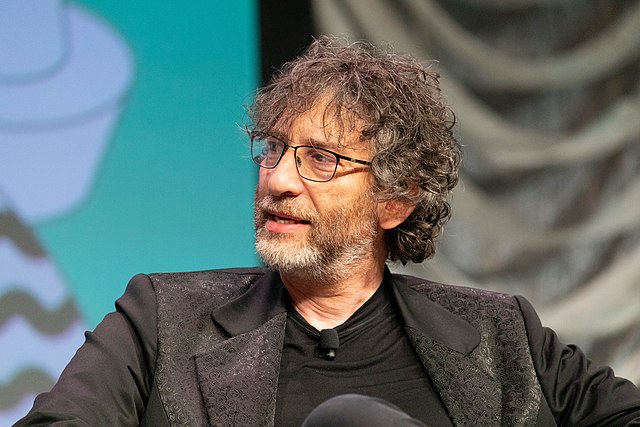
Yes, that all felt rather Gaimanesque, didn’t it? A faint sense of crossing from the mundane world into something softly shimmering and unexpected. Perhaps a talking raven or a cat that seems to know more than it lets on. If that kind of storytelling makes you lean forward with wide eyes, then let me introduce you to the man himself:
Who is Neil Gaiman?
Neil Gaiman (born 1960) is a British author whose tales dance between fantasy and reality with an elegance that can be both comforting and quietly unsettling. He’s a master of weaving ancient myth and modern life together, reminding us that magic can lurk in the strangest places—under a bed, behind an ordinary door, or even at the end of our own nose.
What Should You Read Next?
Gaiman’s writing is often described as having the texture of a half-remembered fairytale—filled with gentle humor, shadows of dread, and the hopeful sparkle of possibility. If that sounds like your next adventure, pick up one of his books. You might find yourself crossing thresholds you never knew existed—and perhaps, returning with a bit more magic in your pocket.